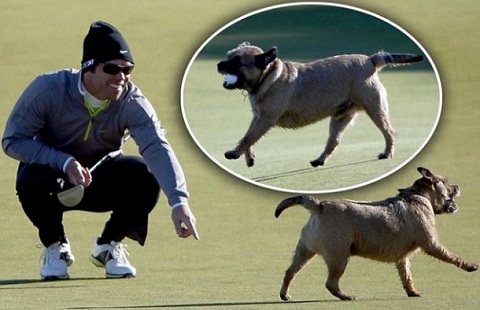
Dog Takes Paul Casey’s Ball
An amusing Rules incident occurred at the Alfred Dunhill Links Championship last Friday. Paul Casey was eyeing-up an eagle putt on the par-5, 12th green at Kingsbarns Golf Links in St. Andrews when a dog picked-up his ball from the putting green and ran off with it. As you can see from the photo, Casey tried to persuade the dog to drop his ball, presumably nearer to the hole, but it ran off gripping it with its teeth. A sprightly spectator caught the ball thief on the 13th and retrieved Casey’s original ball, which he correctly replaced on the green where it had been at rest and took his putt. This was a simple application of Rule 18-1, which states;If a ball at rest is moved by an outside agency, there is no penalty and the ball must be replaced.
|
Category: Rules of Golf
Posts concerning the Rules of Golf
Interference from Sprinklers.
Ladies:
I sent this out a couple of months ago but one of our members wanted me to send it out again as it had come up in her play. Any questions, let me know

No.11 Interference from Sprinklers

Question 1: A player’s ball lies on a sprinkler head. May they take relief from it without penalty?
Answer: Yes, The sprinkler head is an immovable obstruction and the player may drop their ball within one club-length of the nearest point of relief, without penalty, Rule 24-2b(i)
Note that the nearest point of relief for a right-handed player in the photo above is a just off the right hand side of the sprinkler head, even though the player’s stance would be behind it. In other words, they would be standing over the sprinkler head to make their stroke. Once this nearest point has been decided the player may then drop the ball within one club-length of this point, not nearer the hole. This means that the ball could then be dropped on either side of the sprinkler head. If the ball comes to rest in a position in which there is still interference from the sprinkler head, or nearer the hole, then it must be re-dropped.
__________

Question 2: A right-handed player’s ball lies in a place where they would have to stand on the flat sprinkler head in order to play their stroke. May they take relief from the sprinkler head without penalty?
Answer: Yes, a player may take relief without penalty from an immovable obstruction when it interferes with their stance or area of their intended swing, Rule 24-2a.
Question 3: A left-handed player’s ball lies in a place where they say there is mental interference from a flat sprinkler head (as in the second photo above), which is affecting the way that they would like to play their stroke. May they take relief from the sprinkler head without penalty?
Answer: No, there is no relief without penalty for mental interference from an immovable obstruction. Decision 24-2a/1.
__________

Question 4: A player’s ball lies on the apron of the putting green and there is a sprinkler head on their intended line of putt. May they take relief from the sprinkler head?
Answer: No, Rule 24-2 states that, except on the putting green, intervention on the line of play is not, of itself, interference under this Rule.
Note however, that it is common for Committees to introduce a Local Rule when there are sprinkler heads close to the putting green. This is the specimen Local Rule provided in Appendix l of the Rules book;
“Relief from interference by an immovable obstruction may be taken under Rule 24-2. In addition, if a ball lies off the putting green but not in a hazard and an immovable obstruction on or within two club-lengths of the putting green and within two club-lengths of the ball intervenes on the line of play between the ball and the hole, the player may take relief as follows:
The ball must be lifted and dropped at the nearest point to where the ball lay that (a) is not nearer the hole, (b) avoids intervention and (c) is not in a hazard or on a putting green. The ball may be cleaned when lifted.”
Ladies:
If you want a Local Rule put in place you must ask our 18 hole ladies’ group to approve one for our play. Our club does not approve such a Local Rule
Hope this helps you.
Hilary

10 Golden Rules of Golf
Hi Ladies. Here’s a great article about the Rules, enjoy.
THE TEN GOLDEN RULES OF GOLF
The original Rules of Golf issued by the Honorable Company of Edinburgh Golfers in 1744 numbered just 13. Today’s Rules of Golf has 34 Rules with over 200 sections and subsections, totaling more than 20,000 words. It is no wonder that most golfers never bother to read the Rules book at all and that even acknowledged experts will often disagree over the interpretation of some Rules.
If all golfers were to learn these 10 Golden Rules below it is estimated that they would be able to resolve 90% of the Rules situations that golfers routinely encounter in the course of an 18-hole round.
1. Play the ball as it lies.
2. Don’t move, bend, or break anything growing or fixed, except in fairly taking your stance or swing. Don’t press anything down.
3. You may lift natural objects not fixed or growing, except in a water hazard or bunker. No penalty.
4. Movable man-made objects may be moved. For immovable objects, you may take relief by dropping away from them within one club-length of the nearest point of relief, no nearer the hole, except in a water hazard or if the object defines out of bounds. In a bunker, you must drop in the bunker. No penalty.
5. You may take relief from casual water, ground under repair, burrowing animal holes or casts, anywhere except in a water hazard. On the putting green, place at the nearest point of relief, no nearer the hole;otherwise drop within one club-length of the nearest point of relief, no nearer the hole. In a bunker, you must drop in the bunker. No penalty.
6. In a water hazard or bunker, don’t touch the water or ground with your hand or club before the stroke.
7. If you hit your ball into a water hazard and cannot find or play it, either drop behind the point where the ball last crossed the hazard margin or at the place where you played the shot. On the tee, you may tee the ball. One penalty stroke. If you hit into a lateral hazard, you may also drop within two club-lengths of the point where the ball last crossed the hazard margin, or, within two club-lengths of a point equidistant from the hole on the opposite margin. One penalty stroke.
8. When you hit your ball out of bounds or cannot find it after 5 minutes of searching, add a penalty stroke, go back and drop a ball at the place where you played the shot. On the tee, you may tee the ball.If you think you have hit your ball out of bounds or lost it outside a water hazard, play a provisional ball before searching for the first one.
9. When you have an unplayable lie, you may drop a ball at the place where you played the previous shot, adding a penalty stroke. On the tee, you may tee the ball. Alternatively, drop within two club-lengths, no nearer the hole, or any distance behind the unplayable spot, keeping it between you and the hole. If the ball is in a bunker, you must drop in the bunker, under either of the alternative options. If you can’t play your ball that is in a water hazard, see Golden Rule #7.
10. You may repair ball marks and old hole plugs on the putting green that are on the line of your putt, but not spike mark
I hope this helps you!
Hilary


You must be logged in to post a comment.