
10 Golden Rules of Golf

Hi Ladies. Here’s a great article about the Rules, enjoy.

THE TEN GOLDEN RULES OF GOLF

The original Rules of Golf issued by the Honorable Company of Edinburgh Golfers in 1744 numbered just 13. Today’s Rules of Golf has 34 Rules with over 200 sections and subsections, totaling more than 20,000 words. It is no wonder that most golfers never bother to read the Rules book at all and that even acknowledged experts will often disagree over the interpretation of some Rules.
If all golfers were to learn these 10 Golden Rules below it is estimated that they would be able to resolve 90% of the Rules situations that golfers routinely encounter in the course of an 18-hole round.

1. Play the ball as it lies.

2. Don’t move, bend, or break anything growing or fixed, except in fairly taking your stance or swing. Don’t press anything down.

3. You may lift natural objects not fixed or growing, except in a water hazard or bunker. No penalty.

4. Movable man-made objects may be moved. For immovable objects, you may take relief by dropping away from them within one club-length of the nearest point of relief, no nearer the hole, except in a water hazard or if the object defines out of bounds. In a bunker, you must drop in the bunker. No penalty.

5. You may take relief from casual water, ground under repair, burrowing animal holes or casts, anywhere except in a water hazard. On the putting green, place at the nearest point of relief, no nearer the hole;otherwise drop within one club-length of the nearest point of relief, no nearer the hole. In a bunker, you must drop in the bunker. No penalty.

6. In a water hazard or bunker, don’t touch the water or ground with your hand or club before the stroke.

7. If you hit your ball into a water hazard and cannot find or play it, either drop behind the point where the ball last crossed the hazard margin or at the place where you played the shot. On the tee, you may tee the ball. One penalty stroke. If you hit into a lateral hazard, you may also drop within two club-lengths of the point where the ball last crossed the hazard margin, or, within two club-lengths of a point equidistant from the hole on the opposite margin. One penalty stroke.

8. When you hit your ball out of bounds or cannot find it after 5 minutes of searching, add a penalty stroke, go back and drop a ball at the place where you played the shot. On the tee, you may tee the ball.If you think you have hit your ball out of bounds or lost it outside a water hazard, play a provisional ball before searching for the first one.

9. When you have an unplayable lie, you may drop a ball at the place where you played the previous shot, adding a penalty stroke. On the tee, you may tee the ball. Alternatively, drop within two club-lengths, no nearer the hole, or any distance behind the unplayable spot, keeping it between you and the hole. If the ball is in a bunker, you must drop in the bunker, under either of the alternative options. If you can’t play your ball that is in a water hazard, see Golden Rule #7.

10. You may repair ball marks and old hole plugs on the putting green that are on the line of your putt, but not spike mark

I hope this helps you!
Hilary
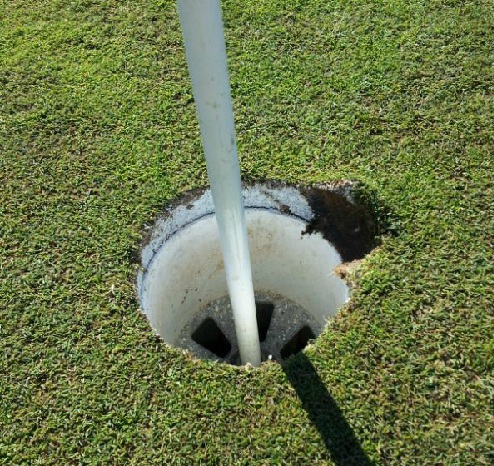
Repairing the lip of a hole………the Rule!

This is a recent communication from a Rules website. As this is a common occurence on our course I though you might all be interested.
Hope this helps you.
Hilary
————————————————

Repairing the Lip of a Hole

Posted: 31 Aug 2012 09:20 AM PDT

12+09+Damged+hole.jpg

When do the Rules of Golf permit a player to repair the damaged lip of a hole? The answer to this question may not be quite as simple as it sounds. Decision 16-1a/5 confirms that if a player touches the inside of a hole they are considered to have touched their line of putt in breach of Rule 16-1a, unless they are doing so to repair damage that was clearly made by a ball, as in the photo above.

So, if the damage to the lip of the hole was made by a flagstick, due to strong winds or having been replaced in the hole sloppily, a player may not repair the damage before making their stroke.

Decision 16-1a/6 clarifies the correct procedure for a player that notices that a hole has been damaged other than by a ball;

Q. Prior to putting, a player discovers that the hole has been damaged. What is the proper procedure?

A. If the damage is not clearly identifiable as a ball mark, then:

(a) If the damage is such that the proper dimensions of the hole have not been changed materially, the player should continue play without repairing the hole. If he touches the hole in such circumstances, a breach of Rule 16-1a occurs.

(b) If the proper dimensions of the hole have been changed materially, the player should request the Committee to have the hole repaired. If a member of the Committee is not readily available, the player may repair the damage, without penalty.

If a player repairs a materially damaged hole when a member of the Committee is readily available, he incurs a penalty for a breach of Rule 16-1a. (Revised)

It is recommended that players should only repair flagstick damage to the edge of a hole after all players in the group or match have completed play of the hole, similar to caring for the course by repairing spike marks near the hole as all players are leaving the putting green. The reason for this is that if the smoothing of any ragged edge to the hole is in any way intended to influence the movement of an opponent’s, fellow-competitor’s or partner’s ball the player incurs a penalty of two strokes for breaching Rule 1-2.

GgNbiwVoybQ?utm_source=feedburner&utm_medium=email

Golf Rules quiz

Ladies:

This happened recently in team play, do you know the answers?


In stroke play, a player’s partner uses the flagstick to point out the line of putt. Which of the following statements are correct?

a) There is no penalty whether or not the flagstick touches the green on the estimated line of putt.

b) There is no penalty if the flagstick does not touch the green on the estimated line of putt.

c) The player incurs a two stroke penalty whether or not the flagstick touches the green on the estimated line of putt

d) The player incurs a two stroke penalty if the flagstick touches the green on the estimated line of putt.

Answer:
b) and d).

Rule 8-2b.

When the player’s ball is on the putting green, the player, his partner or either of their caddies may, before but not during the stroke, point out a line for putting, but in so doing the putting green must not be touched. A mark must not be placed anywhere to indicate a line for putting. Penalty for Breach of Rule: Match play – Loss of hole; Stroke play – Two strokes.

In stroke play in pointing out the line of putt a player’s partner touches the putting green behind the hole with the flagstick. Does the player incur any penalty?

Answer:

Yes.

Even though the line of putt does not extend beyond the hole Rule 8-2b prohibits the putting green being touched to point out a line of putt when the player’s ball lies on the putting green. There is no penalty if the player’s ball lies off the putting green.

Hope you got them correct and this helps you.

Hilary