
Rules and Kevin Na

Ladies:

If I had won the lottery this week I could not have been more popular. Everyone I saw asked me “How come Keven Na took relief from a cart path and he was STILL standing on it” The TV coverage and explanation was bad but all I could assume is that he was really getting relief from Ground Under Repair/Abnormal Ground Conditions. Finally I found this article which has the scoop on what he was doing.

Now we know, and I am impressed that many of you knew what was right and/ or wrong too.

Hilary
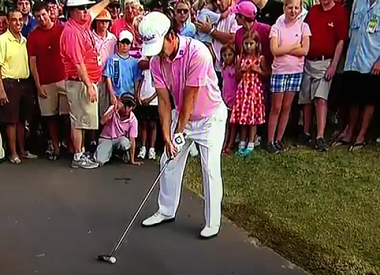
12+05+Kevin+Na+plays+of+path.png

I have not seen the TV coverage of the final round of the Player’s Championship in TPC Sawgrass last Sunday, but I have received several enquiries asking why Kevin Na was permitted to play his ball from off the road on the 18th hole after taking relief. It was suggested that this was a breach of the Rules as he had not taken complete relief, as required by Rule 24-1b

Once again the TV commentators seem to have caused some of this confusion by speculating that he was given the option of taking relief because a curb at the side of the path interfered with his stance. In fact, this was not the case. The walking Rules Official had informed Na that he was entitled to take free relief because his ball was lying in an abnormal ground condition close to the path, apparently caused by recent crowd damage.

He then proceeded according to the Rules, which was to determine the nearest point of relief where there was no interference from the abnormal ground condition and was not nearer the hole, and drop his ball within one club-length of this point, which happened to be on the asphalt path. I understand that Na dropped his ball twice on the path and each time it rolled closer to the hole. He then correctly placed the ball where it had hit the road after the second drop. Because the asphalt path is an immovable obstruction he could then have taken free relief again by determining the nearest point of relief from it, not nearer the hole, and dropping a ball within one club-length of that point. However, he obviously decided that the lie that he had after placing his ball on the road was likely to be better than dropping the ball on the trampled grass at the side of the road. It is not mandatory for players to take relief from immovable obstructions (Rule 24-2b) and he chose not to do so.

Hindsight suggests that he made the right decision as he was able to play a great shot onto the green and made his par with two putts.

Match Play Rules part two

As promised here is the second part of:

“How Match Play Rules differ to Stroke Play Rules”

1. A player may practice anywhere on the course, on the day of the match. Rule 7-1.

2. If you play a stroke and your ball hits your opponent, his caddie, or his equipment you can choose whether to replay the stroke or accept it and play your next shot from where it comes to rest. Rule 19-3. This might not seem fair if your wild shank has hit your opponent where it hurts and stops at his feet, but that is the Rule, so use it when it benefits you.

3. Similarly, if a player, when starting a hole, plays a ball from outside the teeing ground, there is no penalty, but the opponent may immediately require the player to cancel the stroke and play a ball from within the teeing ground. If you think they have made a spectacular shot you can make them rehit, a lousy shot don’t recall it!

4. Here is an unusual one, which not many match players know about. If a putt from the putting green hits another ball at rest on the putting green, whether it is your side or your opponents’ there is no penalty in match play, whereas there is a two stroke penalty in stroke play. Rule 19-5. Just play your ball from where it comes to rest and ensure that the ball that you moved is replaced back to where it was.

5. You are not required to keep a score card in match play, as each hole is either won by one side or the other, or halved between them, and the winner is the player who wins the most holes. For example, if a player is 3 holes up and there are only two holes of the stipulated round remaining the match is over with a result of 3 and 2. (NOTE In “our” team play we do as we count the number of holes won.)

6. In stroke play players may not suspend play for bad weather, unless they consider there is danger from lightning. If they do, the Committee would be justified in disqualifying them. Not so in match play, where players may discontinue their match by agreement, unless by so doing the competition is delayed.
If a match is discontinued by agreement, e.g. due to darkness or threat of lightning, the match must be resumed from where it was discontinued; the players do not start the round again.

7. Unlike stroke play, where you have an obligation to your fellow competitors to report every breach of a Rule that you witness, you DO NOT have to in match play situations, as you may disregard, or overlook any breach of a Rule by your opponent. The reason for this is that only you, or your side, are affected. It does not affect anyone other entrant in the match play competition. However, you still must not say anything to your opponent, as under Rule 1-3 there cannot be agreement with your opponent to waive any penalty incurred by either side.

8. If a player incurs a penalty that was not observed by their opponent they must inform the opponent as soon as practicable. If the player fails to do so before their opponent makes their next stroke they lose the hole, Rule 9-2b. This penalty also applies if a player gives incorrect information during play of a hole regarding the number of strokes taken and does not correct the mistake before their opponent makes their next stroke.

Finally, players competing against each other in a match are opponents; in stroke play a fellow-competitor is any person with whom the competitor plays their round. Neither is partner of the other.

Match play is a great format but when you play make sure that you understand where the Rules differ from those that cover Stroke play that you are more familiar with. With our Team Play about to start I hope this helps you.

Hilary

The second part……Rule 26 (Hilary)

Ladies:

Let me continue to try to explain the logic from last time with the Water Hazard Rule 26. Often I am asked, “If I can hit a provisional ball for a lost ball or ball out of bounds why not for the Water Hazards rule?”

With a ball OB or lost you only have ONE OPTION, hit from where you were before, under “stroke and distance” one stroke penalty. To hit from where you were before is your ONLY choice and because of this it is designed to speed up play as, if you find your ball you can pick up your provisional ball, no penalty.

Under Rule 26, Water Hazards you have 3 or 5 options. When any Rule in golf has more than one option ONCE YOU HAVE CHOSEN TO DROP A BALL UNDER THE ONE OF THE OPTIONS, YOU CANNOT then pick it up and choose a different option. The ball is IN PLAY under that option.

So……………YOU DROP AND HIT A SECOND BALL because you think your ball went into the water hazard….

1. You go ahead and find your ball BUT as you already dropped one, it is taken as fact that you chose the “stroke and distance option” 26-1a, and your ball is in play, too late! You are laying 3.

2. You go ahead and when you get there it was seen to go in the water by someone but you are still lying 3, whereas you could have dropped a ballJUST TWO CLUB LENGTHS AWAY from where it went in, for the same one stroke cost, and you’d be closer to the hole, too late!

The way this Rule 26 works is that by having you go and see if your ball went in the water, as you are not “virtually certain”, it protects the players by allowing ALL their options to be open.

Also if you allowed people to assume their ball went into a hazard they could often get an unfair advantage in distance for that hole. Let me explain.

If just because they didn’t SEE their ball go in, and they were allowed to drop a ball nearer the hole where they “thought” it went in, they would be getting an unfair advantage because in reality their ball might be laying further back from the hole, or had even bounced out of bounds, and they just didn’t bother to look for it. If they were allowed to do this they would be getting a great distance advantage over the field of players, aka cheating!

If you don’t SEE it, or FIND it, or are VIRTUALLY CERTAIN, it’s back to where you were before and take a one stroke penalty.

Golf is a game of integrity and all players have to be protected from folks “bending” the rules and assuming what happened.

I hope this last explanation helps you.

Next time it’s all about local rules and when can we use them and why don’t WE have some of them on our course?

Hilary